Planning a trip across Himachal Pradesh can feel a bit confusing at first. There are so many places people talk about—some famous, others hidden—and it’s hard to know where to begin. Even for those just trying to understand the state better, having a clear picture of its districts really helps.
That’s exactly what this guide is here for.
Whether someone is looking for how many districts are in Himachal Pradesh, trying to understand the geography and culture for academic reasons, or choosing the right places to visit for nature and adventure—this article makes it easier. It includes a mix of practical travel advice, educational facts, and essential district-level information to help readers explore, learn, and plan better.
Let’s dive into our Himachal—a land of 12 distinct districts, each with its own identity.
How Many Districts Are There in Himachal Pradesh?
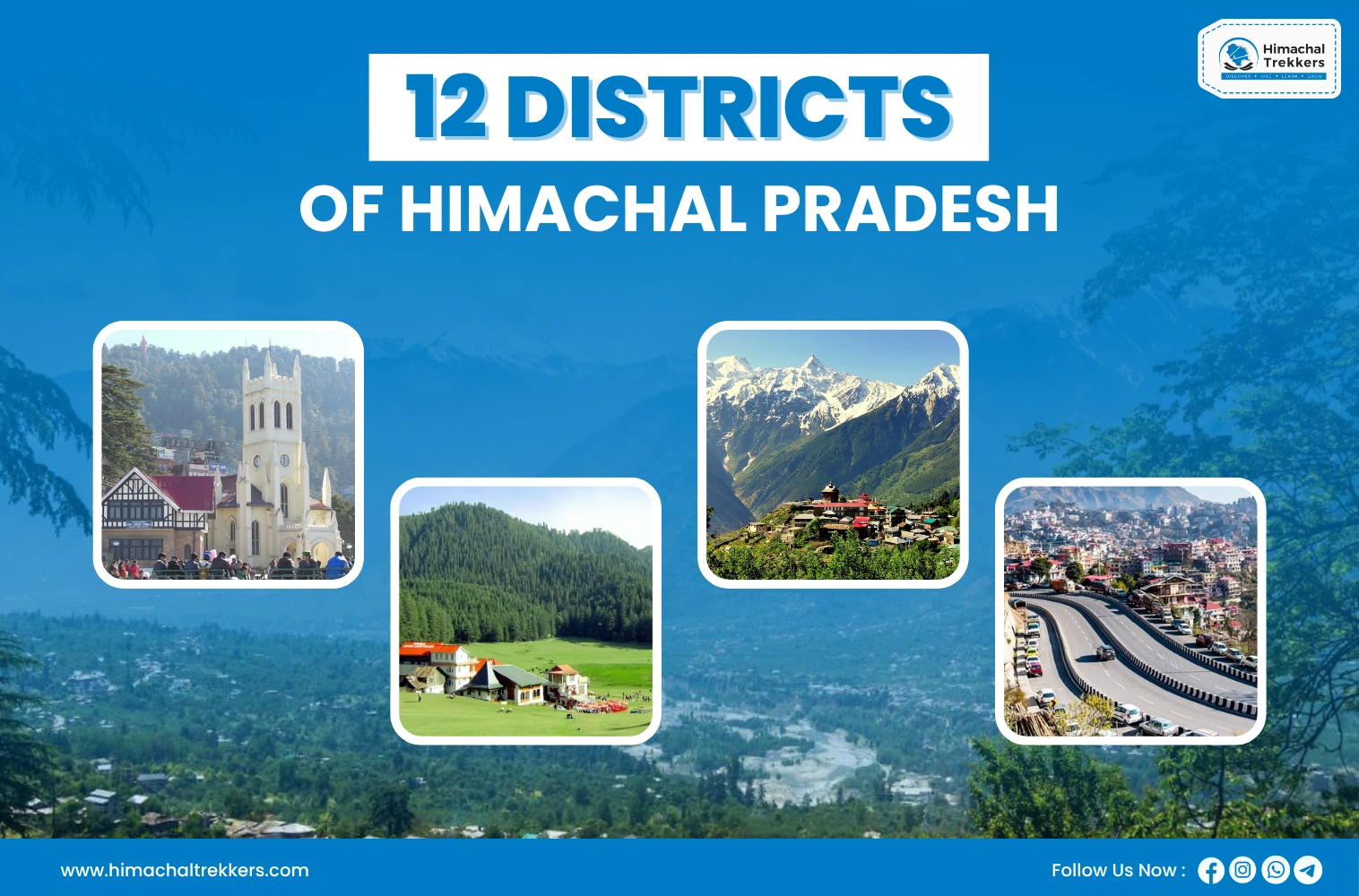
As of 2025, Himachal Pradesh consists of 12 districts, grouped under three administrative divisions.
- Mandi Division
- Shimla Division
- Kangra Division
These districts span from lush green valleys to high-altitude deserts and offer everything from spiritual getaways to adventurous treks.
Himachal Pradesh, a scenic and culturally rich state in northern India, was officially formed as a full-fledged state on 25th January 1971. Since then, it has grown into one of the most beloved travel destinations in the country—known for its peaceful lifestyle, rich heritage, and incredible natural beauty.
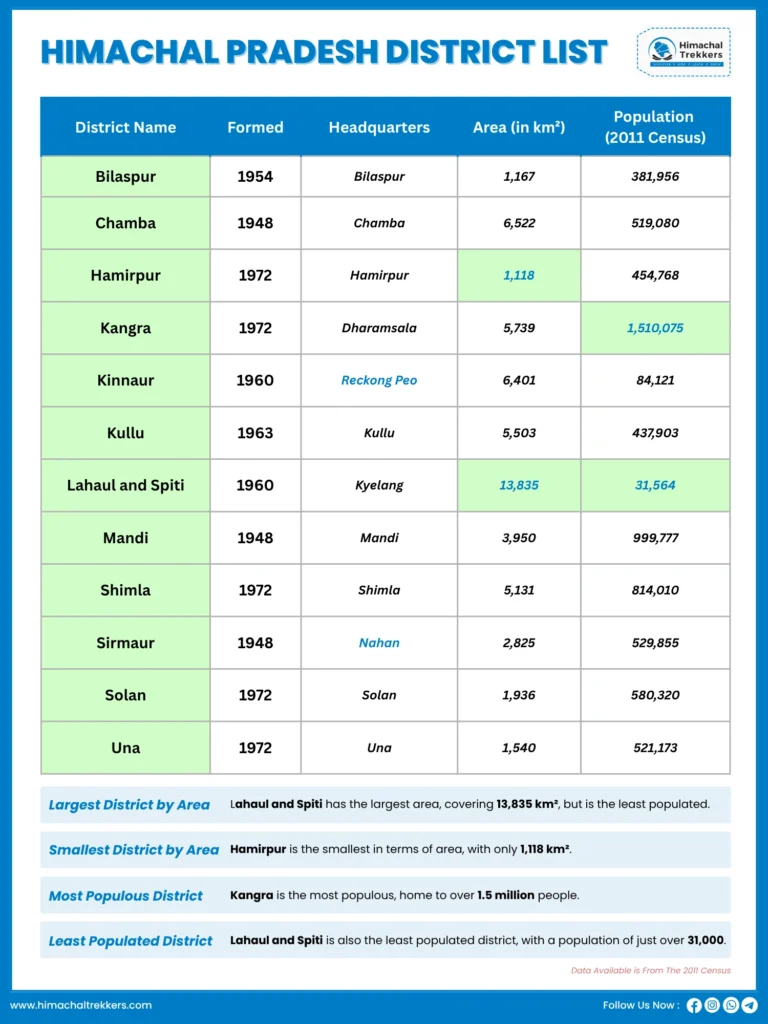
Himachal Pradesh District List With Population & Administrative Overview
1. Kangra District
Kangra is the most populous district in Himachal Pradesh, with Dharamshala as its administrative headquarters. It plays an important role not just politically, but also culturally and historically. Dharamshala is home to the Tibetan government-in-exile and the residence of His Holiness the 14th Dalai Lama, making it a center for Tibetan Buddhism and global peace seekers.
Besides tourism, Kangra contributes to education, with several reputed institutions and universities. Its natural beauty, rich heritage, and spiritual energy make it one of the most visited and admired districts in Himachal Pradesh.
- Top Attractions:
- McLeodganj (Little Lhasa)
- Bhagsunag Waterfall
- Kangra Fort
- Palampur Tea Gardens
- Bir Billing (Paragliding capital of India)
2. Mandi District
Strategically located at the center of the state, Mandi acts as a vital connector between Kullu, Kangra, and Shimla regions, making it an important hub for travel and trade in Himachal Pradesh. It hosts several key administrative offices and government institutions, contributing to its regional importance.
Mandi is also popularly known as “Choti Kashi (छोटी काशी)”, a title it earns due to the presence of over 80 ancient temples dedicated to various Hindu deities, many of which are situated along the banks of the Beas River. The town has deep spiritual roots and plays a central role in local religious events and fairs. The famous International Mandi Shivratri Fair, celebrated every year, draws thousands of devotees and tourists from across the region.
With a rich blend of heritage, religion, and natural beauty, Mandi is a district where tradition and tranquility meet.
- Top Attractions:
- Prashar Lake
- Barot Valley
- Shikari Devi Temple
- Rewalsar Lake
3. Shimla District
Shimla, the capital of Himachal Pradesh, is one of the most visited hill stations in North India. Known for its pleasant weather, scenic beauty, and colonial architecture, it plays a dual role as both the political hub of the state and a major tourism hotspot. It is also sometimes referred to as the “Queen of the Hills” due to its scenic beauty and location in the Himalayas. Shimla also served as the summer capital of British India, and traces of the colonial era can still be seen in its buildings, churches, and old-world charm.
The district is well-connected by road, and the Kalka-Shimla toy train, a UNESCO World Heritage Site, adds to the nostalgic experience of reaching this hill town. Shimla is also a starting point for exploring nearby districts like Kinnaur and Kullu.
Top Attractions:
- The Mall Road & Ridge – Heart of Shimla, lined with shops, cafes, and colonial buildings
- Kufri – Known for snowfall, skiing, and fun adventure parks
- Mashobra – A peaceful retreat with apple orchards and forest walks
- Jakhoo Temple – A hilltop temple dedicated to Lord Hanuman with panoramic views
- Viceregal Lodge – A historic building that once housed British viceroys, now the Indian Institute of Advanced Study
Shimla is perfect for those looking to experience a blend of history, modern comforts, and mountain beauty all in one place.
4. Kullu District
Kullu is one of the most loved districts in Himachal Pradesh and is often called the “Valley of Gods.” It plays an important role in tourism and fruit farming—especially apples, plums, and apricots. The district is famous for the colorful Kullu Dussehra festival, celebrated with great energy every year. It’s also easy to reach, thanks to good road connections and Bhuntar Airport nearby. For many travelers, Kullu is the starting point to explore nearby valleys, mountain passes, and adventure spots.
- Top Attractions:
- Manali – A popular hill station known for its snow-covered peaks, charming cafes, nearby offbeat villages, and plenty of adventure activities.
- Solang Valley – Great for skiing, snowboarding, paragliding, and more.
- Parvati Valley (Kasol, Tosh, Malana) – Peaceful and scenic, perfect for trekkers and nature lovers.
- Great Himalayan National Park – A UNESCO World Heritage Site filled with wildlife, forests, and trekking trails.
- Bijli Mahadev Temple – A sacred spot with incredible views and a fascinating legend.
- Naggar Castle – A historic wooden castle offering a glimpse into Himachali heritage.
- Atal Tunnel (Rohtang) – One of the world’s highest road tunnels, connecting Manali to Lahaul Valley. It has made travel to the high-altitude regions easier and quicker, even in winter.
- Manali – A popular hill station known for its snow-covered peaks, charming cafes, nearby offbeat villages, and plenty of adventure activities.
Whether you’re visiting for the adventure, the peace, or the festivals, Kullu has a little bit of everything—making it one of the most unforgettable places in Himachal Pradesh.
5. Chamba District
Chamba is in the northwestern part of Himachal Pradesh and shares its border with Jammu and Kashmir. It is one of the first districts in the state, established in 1849 and was once a princely kingdom. The town of Chamba is known for its old temples, beautiful artwork, and traditional crafts like the Chamba Rumal (embroidered handkerchiefs) and Pahari miniature paintings. It also holds importance because of its location near the state border.
- Top Attractions:
- Dalhousie – A peaceful hill station with old British-style buildings and pine forests.
- Khajjiar (Mini Switzerland) – A lovely green meadow with forests all around. Great for relaxing and clicking photos.
- Chamera Lake – A large man-made lake, perfect for boating and enjoying nature.
- Manimahesh Kailash Yatra – A famous spiritual trek to a holy lake near the Manimahesh Kailash Peak.
- Bhuri Singh Museum – A place to see the history, art, and culture of Chamba.
- Lakshmi Narayan Temple Complex – A group of very old temples that are still visited by many people today.
- Dalhousie – A peaceful hill station with old British-style buildings and pine forests.
Chamba is full of natural beauty, culture, and peaceful spots. It’s a great place for travelers who want to enjoy both nature and history.
6. Bilaspur District
Bilaspur is one of the important districts of Himachal Pradesh. It is home to the famous Bhakra Dam, which helps produce electricity and provides water for farming in many nearby states. The old town was submerged when the Gobind Sagar Lake was created, and the new town was carefully planned and built.
- Top Attractions:
- Gobind Sagar Lake – A large, peaceful lake where visitors can enjoy boating, fishing, and other water activities.
- Vyas Gufa – A cave believed to be where sage Vyas wrote parts of the Mahabharata.
- Naina Devi Temple – A popular pilgrimage site on a hilltop, visited by thousands of devotees.
- Kandrour Bridge – A tall and strong bridge offering amazing views of the Satluj River.
- Markandeya Temple – A quiet and spiritual spot surrounded by nature.
- Gobind Sagar Lake – A large, peaceful lake where visitors can enjoy boating, fishing, and other water activities.
Bilaspur offers a mix of natural beauty, religious places, and modern wonders. It’s a great place for those who enjoy peaceful views, water activities, and exploring stories from the past.
7. Solan District
Solan is often called the “Mushroom City of India” because it’s known for growing mushrooms and even has a special mushroom research center. It’s also a growing hub for farming, horticulture, and industries. The nearby town of Baddi is one of the biggest industrial areas in India, especially for medicine manufacturing. Solan also has one of Asia’s first universities focused on plants and trees—Dr. Y.S. Parmar University of Horticulture and Forestry.
- Top Attractions:
- Kasauli – A quiet and charming hill station with colonial buildings, walking trails, and amazing views.
- Barog – A small, scenic town on the Kalka–Shimla toy train route, famous for its long railway tunnel and peaceful vibe.
- Shoolini Mata Temple – A popular temple where locals celebrate the Shoolini Mela every year with great energy.
- Jatoli Shiv Temple – One of the tallest Shiva temples in Asia, built in traditional South Indian style.
- Mohan Heritage Park – A beautifully designed cultural park that showcases Indian heritage, spirituality, and nature. It’s a peaceful place for families and anyone who wants to experience art and culture in a quiet setting.
- Riva Waterfall – Also known as “Solan Waterfall,” this hidden gem is a refreshing natural spot ideal for short hikes, nature photography, and spending peaceful moments in the lap of nature.
- Kasauli – A quiet and charming hill station with colonial buildings, walking trails, and amazing views.
Solan is a lovely mix of nature, learning, culture, and calm. Whether you’re passing through or staying a while, it has something to offer for everyone.
8. Una District
Una is known as the main entry point to Himachal Pradesh from Punjab. It’s located in the low hills, so the weather here is warmer compared to the rest of the state. Because of its location, Una plays an important role in connecting Himachal to the plains. It has good roads and rail links, making travel easy. The district is also part of a popular religious circuit, and many people visit here every year for spiritual reasons.
- Top Attractions:
- Pong Dam Reservoir – A peaceful spot, perfect for birdwatching—especially in winter when migratory birds arrive.
- Chintpurni Temple – A major pilgrimage site and one of the Shakti Peethas, loved by both locals and tourists.
- Dera Baba Rudru – A calm spiritual place surrounded by greenery.
- Thaneek Pura – A quiet village near Chintpurni, great for small walks, local fairs, and temple visits.
- Pong Dam Reservoir – A peaceful spot, perfect for birdwatching—especially in winter when migratory birds arrive.
Una is a great place to start your Himachal journey—offering spiritual peace, nature, and easy travel all in one district.
9. Hamirpur District
Hamirpur is one of the most educated districts in Himachal Pradesh, with a literacy rate consistently ranking among the highest in the state. It is often referred to as the “Veer Bhoomi” due to its large contribution of personnel to the Indian Armed Forces. The district has a balanced climate, making it comfortable to visit almost year-round. It is also known for its peaceful lifestyle and well-developed infrastructure.
- Top Attractions:
- Deotsidh Temple: A highly revered shrine dedicated to Baba Balak Nath, attracting thousands of devotees every year.
- Sujanpur Tira: A historic town with ancient forts, temples, and scenic beauty along the Beas River. It was once the capital of the Katoch dynasty.
- Nadaun: A picturesque town on the banks of the Beas River, known for its historical significance and calm surroundings.
- Gasota Mahadev Temple: A peaceful Shiva temple located in a natural setting, ideal for spiritual seekers.
- Deotsidh Temple: A highly revered shrine dedicated to Baba Balak Nath, attracting thousands of devotees every year.
Hamirpur is a district that reflects the spirit of devotion, discipline, and simplicity—qualities deeply rooted in Himachali culture.
10. Sirmaur District
Located in the southeastern part of Himachal Pradesh, Sirmaur is known as the “Peach Bowl of India” due to its large-scale fruit production—especially peaches and plums. Agriculture is the backbone of the district, but in recent years, tourism has also seen steady growth. The district shares a border with Uttarakhand and is important for trade and cultural exchanges in the lower Himalayan region.
- Top Attractions:
- Renuka Lake – The largest natural lake in Himachal, associated with the legend of Goddess Renuka and her son Parshuram.
- Churdhar Peak – The highest peak in the outer Himalayas (approx. 3,647 meters), offering a rewarding trek and religious significance.
- Nahan Town – A quiet, well-planned town known for its cleanliness, gardens, and colonial charm.
- Renuka Lake – The largest natural lake in Himachal, associated with the legend of Goddess Renuka and her son Parshuram.
11. Kinnaur District
Kinnaur, located along the Indo-Tibetan border, is a tribal district with deep-rooted traditions, scenic valleys, and a unique mix of Hindu and Buddhist cultures. It’s one of the least populated regions in the state but holds great strategic importance due to its border location. Kinnaur is also known across India for its delicious Kinnauri apples, and the Satluj River flows through its rugged terrain, supporting major hydropower projects.
- Top Attractions:
- Kalpa – A charming village offering stunning views of the Kinnaur Kailash range, known for its traditional wooden homes and peaceful vibe.
- Kinner Kailash – A sacred mountain peak (6,050 meters approx.) considered the mythical abode of Lord Shiva, attracting pilgrims and trekkers alike.
- Sangla Valley – Famous for its lush pine forests, quiet riversides, and traditional Himachali architecture.
- Chitkul – The last inhabited village near the Indo-China border, untouched and incredibly scenic.
- Bhimakali Temple (Sarahan) – One of Himachal’s most revered temples, featuring beautiful wooden architecture and spiritual significance for both Hindus and Buddhists.
- Kalpa – A charming village offering stunning views of the Kinnaur Kailash range, known for its traditional wooden homes and peaceful vibe.
12. Lahaul & Spiti District
Lahaul & Spiti is the largest district in Himachal Pradesh by area but also one of the least populated regions. It is known for its cold desert climate, rugged terrain, and unique culture shaped by Tibetan Buddhism. During winters, heavy snowfall often cuts off parts of the district, and travel requires planning and permits. It plays a key role in national security and border access, especially with the construction of the Atal Tunnel, which connects Lahaul to the rest of the state year-round.
- Top Attractions:
- Chandratal Lake – A stunning high-altitude lake shaped like a crescent moon, popular among trekkers and campers.
- Key Monastery – One of the largest and oldest monasteries in Spiti Valley, offering panoramic views and spiritual serenity.
- Tabo Monastery – Known as the “Ajanta of the Himalayas,” this over 1,000-year-old monastery is a UNESCO heritage site candidate.
- Hikkim – Home to the world’s highest post office, where visitors still send postcards from the edge of the world.
- Pin Valley National Park – A protected zone rich in Himalayan flora and fauna, including the elusive snow leopard.
- Chandratal Lake – A stunning high-altitude lake shaped like a crescent moon, popular among trekkers and campers.
Himachal Pradesh Map District-Wise
Nowadays, the internet is available almost everywhere—and you can easily find routes, directions, and suggestions online. However, if you’re heading into remote valleys, high passes, or tribal circuits where mobile networks may disappear, then an offline map becomes your best travel partner.
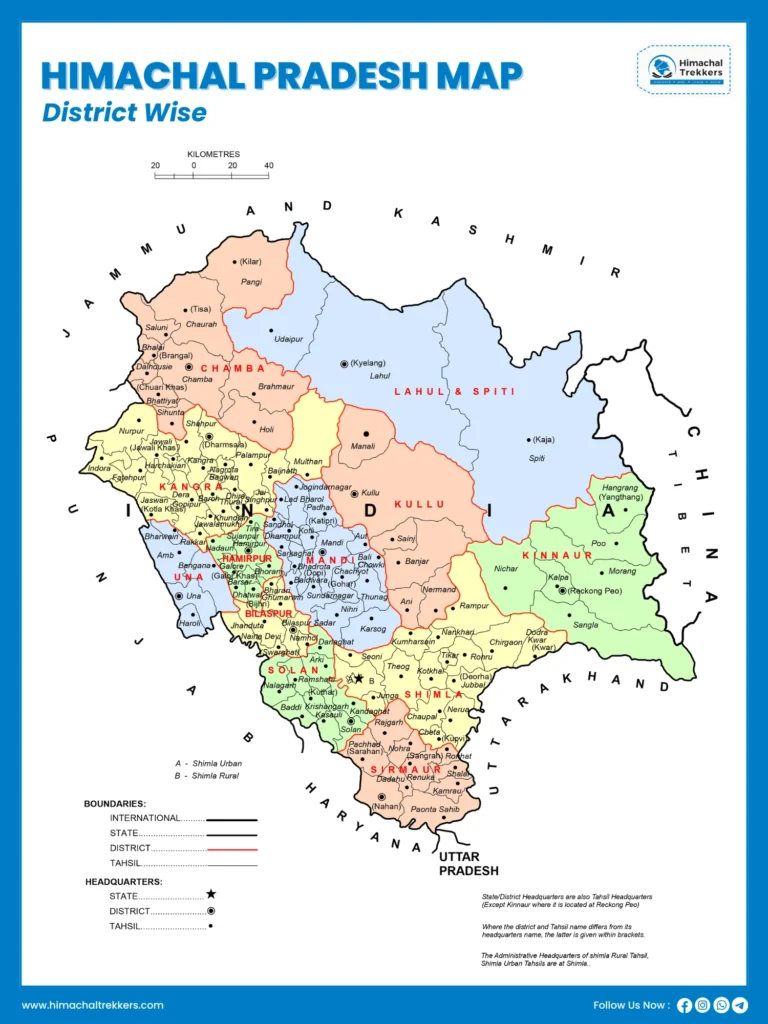
Why a District Map is Useful:
- Better Itinerary Planning: Knowing which districts are close to each other helps in grouping destinations (e.g., exploring Kinnaur and Spiti together).
- Understanding Terrain Changes: While Kangra and Hamirpur have sub-tropical valleys, Lahaul-Spiti and Kinnaur have alpine and cold desert landscapes.
- Climate Awareness: Some districts remain snowbound in winter (like Spiti and Lahaul), while others are accessible year-round (like Solan, Una, and Bilaspur).
- Local Transport Planning: District-wise planning helps when checking public transport routes (HRTC), road connectivity, or booking inter-district taxis and buses.
Conclusion: Exploring the Diversity of Himachal Pradesh
Understanding the district-wise layout allows travelers to plan smarter routes, explore offbeat paths, and experience Himachal in a way that’s personal and meaningful. For students, researchers, and those seeking to understand Himachal from a cultural, geographical, or environmental lens—this district guide provides a solid foundation.
So whether someone is sketching their first itinerary or revising for a competitive exam—knowing these 12 districts is the first step to truly understanding “Our Himachal.”
And remember: in Himachal Pradesh, every road leads to a new story, every district has its own heartbeat, and every visit feels like coming home.